abraham lincoln abraham maslow academic papers africa aging aid alexander the great amazon america android os apple architecture aristotle art art institute chicago astronomy astrophysics aubrey de grey beck beer berlin bernacke bicycle BIG bill murray biophilia birds blogs bob dylan books bourdain brewing brian wansink buckminster fuller bukowski cameras cancer carl jung carl sagan cemetary change charter city chicago china christmas church civil war climate change cologne construction coop himmelblau copenhagen cornell west cps craigslist crime crown hall cyanotype cyrus dalai lama darkroom data dbHMS death design build dessau detail Diet dogs dome dongtan douglas macarthur drake equaation dresden dubai ebay eco economics economy education einstein emerson emily dickinson energy experiments facebook farming finance finland florida food france frank lloyd wright frei otto freud frum funny furniture games gay rights gdp george w bush george washington germany ghandi glenn murcutt goals good google government graphic design guns h.g. wells h.l. mencken hagakure halloween health health care henri cartier bresson herzog and demeuron honey housing human trafficking humanitarian efforts hydroponics ideas iit indexed india industrial design industrial work internet investments japan jaqueline kennedy jim cramer john maynard keynes john ronan john stewart journalism kickstarter kings of leon kittens krugman kurt vonnegut kurzweil lao tzu law le corbusier ledoux leon battista alberti links LSH madoff malcolm gladwell marijuana marriage masdar city math mead medicine microsoft mies van der rohe military milton friedman mlk money movies munich murphy/jahn music nasa nervi neutra new york nickel nietzsche nobel prize norman foster nsa obama occupy open source paintball palladium print paris parking party passive house paul mccartney persia philip roth philosophy photography picturequote pirate bay pirating plants poetry poker politics portfolio potsdam predictions prejudice presidents process photos prostitution psychology public housing q and a quotes rammed earth randy pausch reading reddit regan religion rendering renewables renzo piano restaurants revolution richard meier richard rogers robert frank rome rubik's cube rule of 72 rumi san francisco sartre sauerbruch hutton saule sidrys schinkel school science screen printing seattle sesame street seth roberts sketch social media soviet sparta spider spinoza sports stanley kubrick stanley milgram statistics steinbeck sudhir venkatesh suicide sustainable design switzerland taxes technology ted teddy roosevelt tension terracotta tesla thanatopsis the onion thomas jefferson thoreau time lapse tommy douglas transportation travel truman tumblr unemployment urban design van gogh venezuela vicuna video video games wall street war werner sobek wood woodshop woodworking ww1 ww2
Showing posts with label berlin. Show all posts

23 December 2011

Picturequote

Dear Mother, 
I don't want to be a doctor, and live by men's diseases; nor a minister to live by their sins; nor a lawyer to live by their quarrels. So I don't think there's anything left for me but to be an author. 
Nathaniel [Hawthorne]
A square in Berlin near the Altes Museum. The sign you can only kind of see on the right is Weihenstephaner - my favorite brewery.

03 October 2010

B&W Europe Photos

I still haven't finished posting my photos from Europe on here but here's a few of the B&W 120 film photos made with my Mamiya 645.

A note on my film: The borders of the negatives are shown because my particular view of photography requires that I show what I saw when I took the photo. Hence, the images are not cropped. I rarely if ever dodge and burn. The only adjustments I make are to brightness and contrast - especially since my film of choice is the newer Kodak TMY-2 whereas this is Kodak's older 400TX, so a lot of my film turned out grainy and overdeveloped - I was being willfully dense when I developed it. C'est la vie.

The following three photos are of the Sony Center in Berlin and were hand held at night...


The Cathedral in Cologne.


The lead covering on Renzo Piano's Auditorium Parco della Musica in Rome.


Richard Meier's Jubilee Church in (the ghetto of) Rome.


Pantheon in Rome - excellent.


Random Rome. Plants grow everywhere and here some vines had turned into a shade for this small gas station. It reminds me of those bridges that people grow in Asia.


Pompidou Center in Paris by Piano and Rogers. I liked it a lot more than I thought I would.


Lundgaard & Tranberg Arkitekter's Tietgen Dormitory in Copenhagen. This was one of if not my favorite contemporary building I've ever visited. The concept/program actually works to form a community.


BIG's (Bjarke Ingles Group) 8 House in Copenhagen.


Big's Mountain Dwelling in Copenhagen.

26 June 2010

Bonn & Cologne - Day 23 & 24 - 2010-6-23,24

The Kölner Dom (Cologne Catherdral). It's massive. Oh yeah, it took 632 years to build and is 157.3 m high (515').


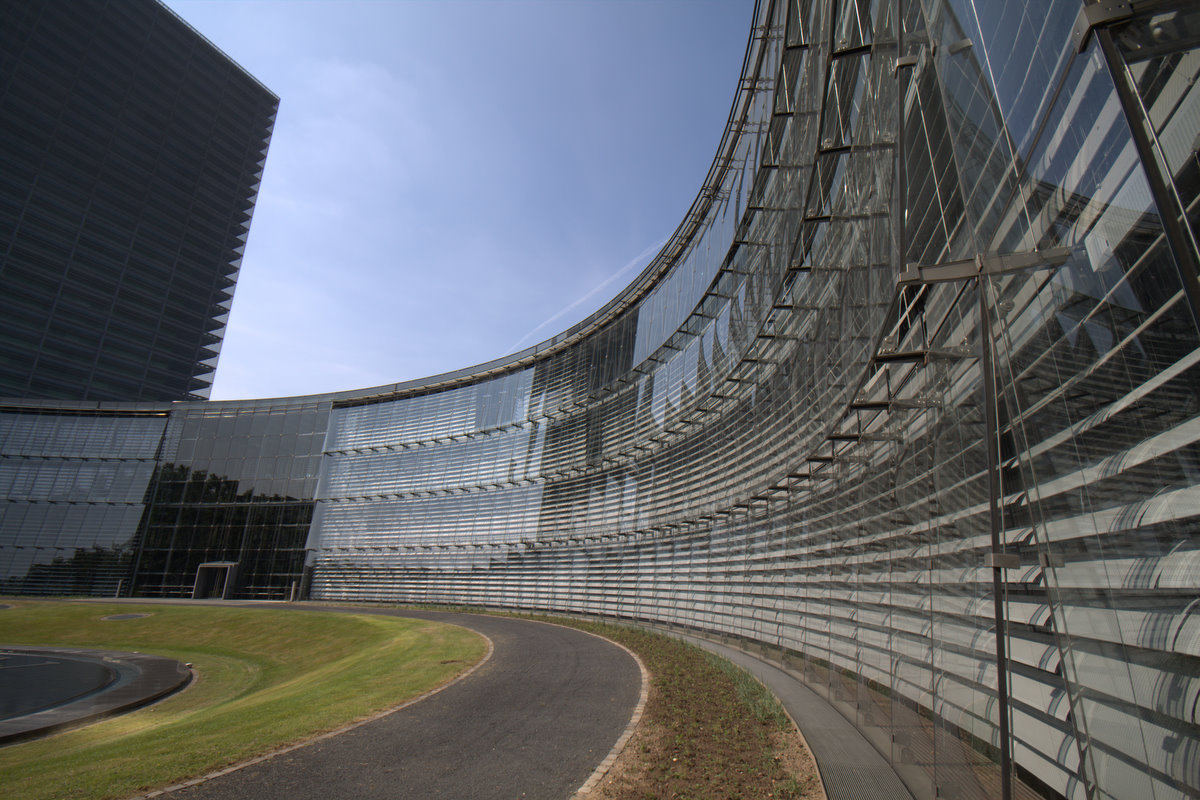
Beyer Headquarters by Helmut Jahn. Werner Sobek is more or less always his structural engineer.


This mechanical room uses waste heat (they say waste steam but... well I work with steam, there's rarely [with the exception of nuclear] such thing as waste steam) to heat and cool the building. It's so efficient that the building isn't required to have any photovoltaics or other zero emissions energy production as is usually required by German building codes.


Serious double facade.


Japanese garden.


Inside the Dom. 97m tall - so about 315'.


28cm x 21cm sketch on newsprint with india ink. This is BIG's Figure 8 building that's still under construction. All I did was draw that day... finals.

Berlin - Day 22 - 2010-6-22

The Church of Reconciliation (Kapelle Versoehung). It was located in the no-man's land between the inner and outer portions of the Berlin Wall, and thus it was demolished in the 1980's. What you seeh was recently rebuilt in its place using the surrounding dirt and debris from the former church to make walls out of rammed earth (similar to concrete but earth from the site makes up most of the mix) on the inside.


Rammed earth on the right. It forms a circle that contains the chapel in the center. You can make out the layers that were added and rammed. It ends up looking like a mix between rough concrete and a sedimentary rock.


The only remaining section of the Berlin wall with an in tact "kill zone" - that is, no-man's land that was cleared so that guards could shoot you if you tried to cross. The memorial is stainless steel on the inside and cor-ten steel (steel that rusts to form a protective patina) on the outside.


The 1936 Olympic Stadium. Designed by Werner March.


Le Corbusier's Unité d"Habitation. Corb's idea was to create a sort of mechanized living habitat, not entirely dissimilar to his fascination with planes; cars, and boats, which contained all the functions needed to live. Commercial space was supposed to be included but it ended up not happening... making it a 17 story high rise in the middle of a field. The German codes required that he raise ceiling heights by at least a meter. All the proportions, based on the golden section, were thrown out and by the time it was completed Corb basically washed his hands of the entire project. Not a big fan of him or this project, but you do have to be semi amazed that this was one of the first buildings (3 of these were built here) of this nature that would soon cover the earth and affect the lives of hundreds of millions of people for generations (see: south side of Chicago).

25 June 2010

Berlin - Day 21 - 2010-6-21

The Sony Center by Murphy/Jahn. Structural engineering by Werner Sobek. Cost - 1 billion DM.


Hung glass facade with vertical tension cables and horizontal structural glass.


This building complex has multiple structural tricks. This one forms horizontal beams with tensioned steel cables to add rigidity to this glass facade. It's extremely materially efficient.


Good view of Mitte.


Jahn keeps his offices here too... so we took a little tour.


The same automated louvered aluminum blinds seen in Neues Kranzler Eck/DIFA.


Murphy/Jahn's library.


Hung glass facade held up by massive steel truss work, suspended by steel cables, and held down by huge springs attached to a massive buried concrete beam.


Glass bottom pond over an angled glass ceiling with terraced garden... must have been a bet over a couple beers.


The kingpin. This pin is the only compressive member of this canopy that translates the tensional force of the white teflon/fiberglass sheathing and steel cables into a positively sloped roof. Imagine standing on a trampoline and holding a sheet over your head - in this case you are the kingpin - that's basically how this building works.


One last note. Why is the kingpin tilted? Imagine the canopy as a cone. If you were to cut out a section perpendicular to the base the cut edge would form a circle as it does at the top. The courtyard is actually an ellipse so the "cut" was made at an angle... clever. Also, the canopy is only fixed to the surrounding buildings at two points, the rest are sliding plates. This allows for expansion and contraction.


Terracotta clad Renzo Piano buildings. It forms a whole complex replete with indoor "canyons" and outside water parks. The terracotta slowly recedes as it nears the edge.

Berlin - Day 18 & 19 - 2010-6-18,19

A Philosophy Library by Norman Foster. It's bigger than it looks. One level is sunken but abutted by a berm. The shallow ground is then covered in rocks and ground cover.


There's a double facade that is computer controlled with operable windows and glass on the outside and a translucent membrane on the inside. The effect is a very soft light and a large amount of energy savings because of the air gap.


The floor plates undulate inside without touching the dome for the most part.


Every project in Germany gets a report card. The big arrow is this building and the little arrow is a typical building of this size.


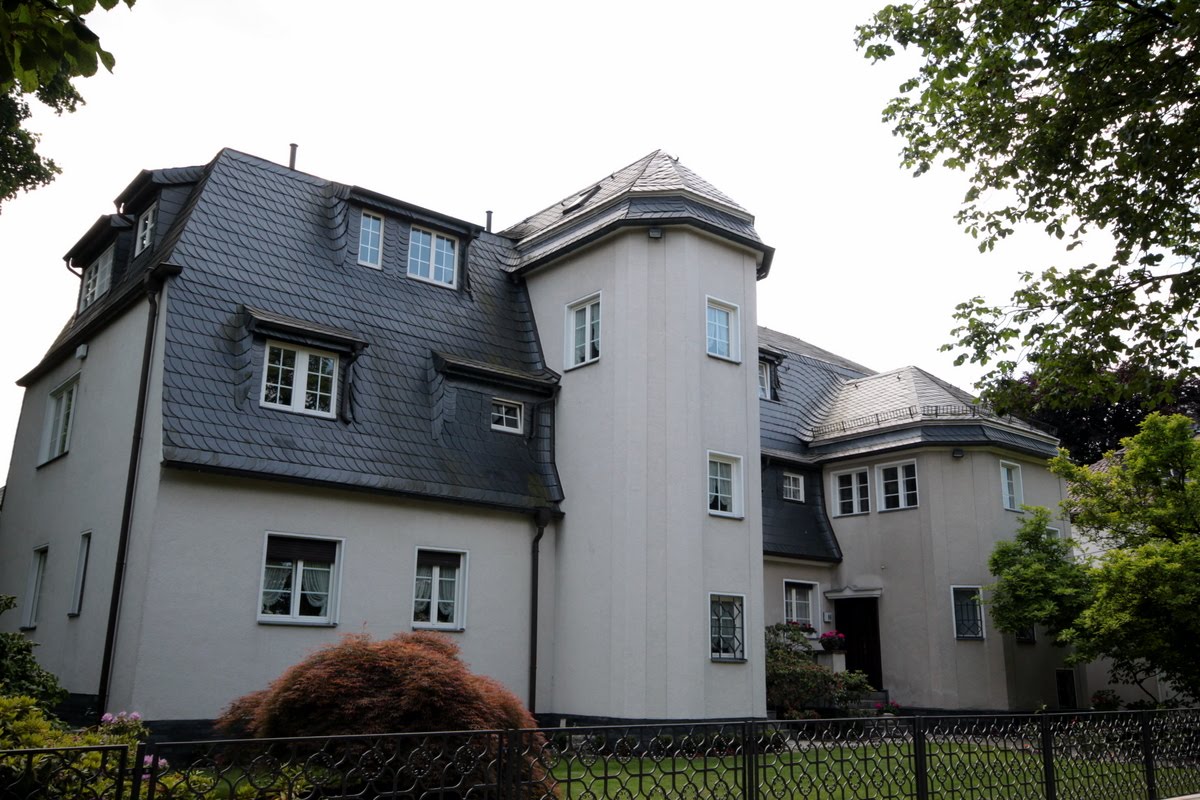
A really well done slate roof. The shingles curve up instead of forming 90's near the fenestration. I wonder if that reduces the need for flashing (the point where most leaks occur)?


I didn't take any real photos on our day off so... here's one of the train.